MCCB Explained: How Moulded Case Circuit Breakers Protect Commercial and Industrial Switchboards
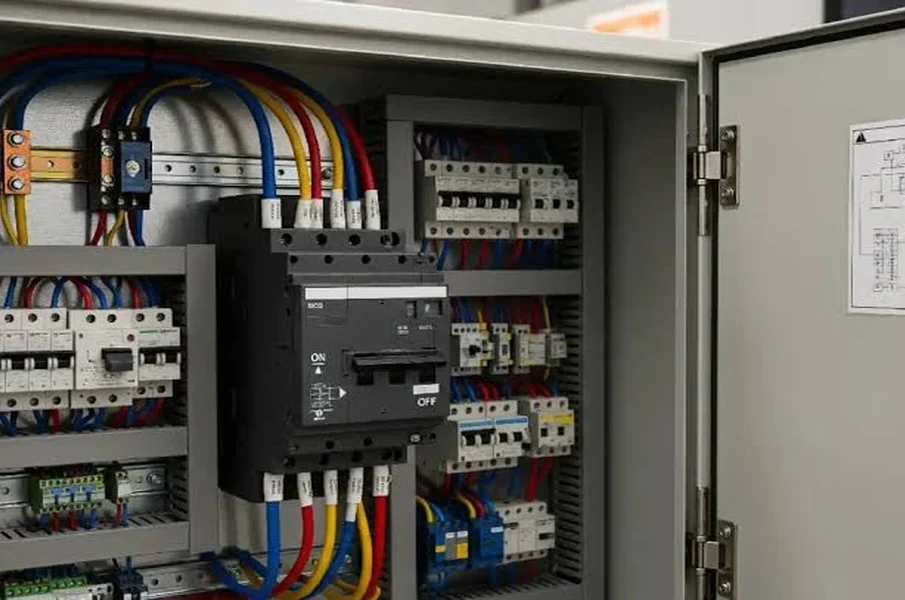
Commercial buildings and factories draw far more current than homes. Their main switchboards need breakers that handle hundreds of amps and very high fault currents.
An mccb, or moulded case circuit breaker, fills that role. It protects cables and equipment from overloads and short circuits. People searching this topic usually want to know how it works and how to choose the right one.
Choosing without a clear method can lead to nuisance tripping, or worse, a breaker that cannot safely clear a fault.
Correct Selection Matters More Than Brand
A well-known brand does not guarantee the right fit. Each breaker must match the installation it protects.
· Match the current rating to the cable and load.
· Check the breaking capacity in kA against the prospective fault current.
· Choose the right trip unit type.
· Confirm the number of poles needed.
· Plan discrimination with upstream and downstream devices.
· Check compliance with AS/NZS IEC 60947.2.
Thermal Magnetic Trip Units
These use two mechanisms. A thermal element responds to sustained overloads. A magnetic element trips instantly on short circuits.
They are simple and reliable for many distribution boards. The limitation is adjustment. Settings are often fixed or only partly adjustable.
Electronic Trip Units
Electronic units measure current digitally. They allow separate settings for long time, short time, and instantaneous protection, and sometimes earth fault.
This helps engineers fine-tune protection across a large site. The difficulty is cost and setup. Settings must be calculated and recorded correctly.
Breaking Capacity and Discrimination
Each mccb must have a breaking capacity above the prospective fault current at its location. Ratings are shown as Icu and Ics on the breaker.
Discrimination means only the breaker nearest the fault trips. In practice, achieving it needs a proper fault study and manufacturer selectivity tables.
Accessories and Mounting Options
Common accessories include shunt trips, undervoltage releases, auxiliary contacts, and motor operators. Breakers can be fixed, plug-in, or withdrawable within a chassis.
These add flexibility for control and maintenance. The limitation is compatibility, since accessories are often specific to a frame size or range.
A Practical Selection Plan
· List the load current for each circuit.
· Obtain the prospective fault level from the design.
· Choose the frame size and current rating.
· Select the trip unit type and settings.
· Check discrimination with upstream devices.
· Have a licensed electrician install and test it.
Where Selection Goes Wrong?
Common mistakes include oversizing breakers “for safety”, ignoring ambient temperature derating, and copying old settings onto new loads.
Conditions also change. Added equipment, solar systems, or larger transformers can raise fault levels beyond the original design.
Keeping Protection Reliable Over Time
Schedule thermal imaging of switchboards. Check terminal torques during maintenance shutdowns. Test trip functions at set intervals. Record settings after every change.
Frequently Asked Questions
· What is the difference between an MCB and an MCCB? MCBs suit lower currents, usually up to about 125 A. MCCBs cover much higher ratings.
· Can I adjust the trip settings myself? Only a qualified person should change settings, based on calculations.
· Do MCCBs need maintenance? Yes. Regular inspection and testing keep them reliable.
· Who can install one in Australia? A licensed electrician.
· What does kA rating mean? It is the maximum fault current the breaker can safely interrupt.
No protection scheme stays perfect forever. Loads change and equipment ages. Careful selection, clear records, and regular testing keep switchboards safe. Consistent maintenance matters more than a perfect design on paper.





-
MCCB Explained: How Moulded Case Circuit Breakers Protect Commercial and Industrial Switchboards
Commercial buildings and factories draw far more current than homes. Their main ... -
-
-
-